Alabama Made Reckless Endangerment a Felony in Some Cases on October 1. Here's What Changed.
Until October 1, reckless endangerment in Alabama was a misdemeanor no matter how many people were put at risk. One person or ten, same charge, same ceiling. That's no longer true. A new law now makes it a felony when the risk reaches more than one person, and a more serious felony when a deadly weapon or dangerous instrument is involved. I've been practicing in Alabama courtrooms for nearly fifty years, and I can tell you that moving a charge from misdemeanor to felony changes almost everything about how a case is handled. So here's what the new law says, in plain terms.
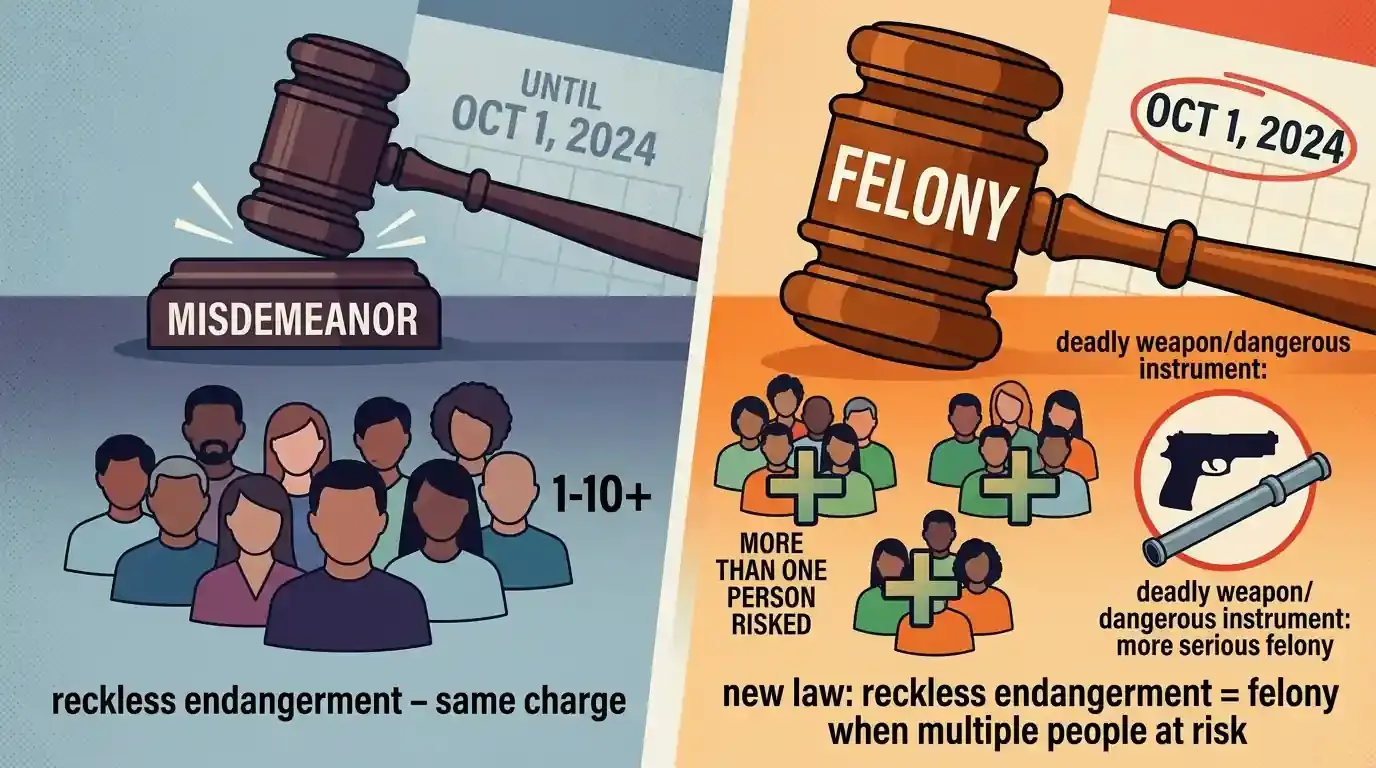
Until October 1, reckless endangerment in Alabama was a misdemeanor no matter how many people were put at risk. One person or ten, same charge, same ceiling.
That's no longer true. A new law now makes it a felony when the risk reaches more than one person, and a more serious felony when a deadly weapon or dangerous instrument is involved. I've been practicing in Alabama courtrooms for nearly fifty years, and I can tell you that moving a charge from misdemeanor to felony changes almost everything about how a case is handled. So here's what the new law says, in plain terms.
The old law
Section 13A-6-24 of the Alabama Code made it a crime to recklessly do something that creates a substantial risk of serious physical injury to another person. It was a Class A misdemeanor, the most serious misdemeanor level, which means up to a year in jail.
Notice what the old law didn't do. It didn't care how many people were put in danger. Firing a gun toward a crowd and firing one toward a single person were charged the same way.
What the Amy Dicks Act changed
The new law is House Bill 266, called the Amy Dicks Act, sponsored by Representative Chris Sells of Greenville. It passed the House in February. The Senate amended it on April 1, and the House agreed to the Senate's changes the same day. It took effect October 1, 2026.
According to news coverage, a House member who spoke in favor of the bill said it came at the request of district attorneys around the state.
The statute now works like this:
- Risk to one person: still a Class A misdemeanor, same as before.
- Risk to multiple individuals: now a Class C felony, which in Alabama carries up to 10 years.
- Risk to multiple individuals with a deadly weapon or dangerous instrument: a Class B felony, which carries 2 to 20 years.
No one has to be hurt. The crime is creating the risk, not the injury.
What kinds of cases this reaches
News coverage of the bill gave a few examples of conduct that can amount to reckless endangerment: driving under the influence, firing a gun into the air, and throwing objects from a high place.
Now picture any of those with more than one person in harm's way. A crowded parking lot. A party. A road with several cars on it. A charge that used to top out at a misdemeanor can now be a felony, and the number of people is what makes the difference.
The law's definition of a dangerous instrument is broad. Under Alabama's criminal code, an object can qualify depending on how it's used, and in some circumstances that can include a vehicle. How far that reaches under this particular provision is something the courts will have to sort out. If your case involves a vehicle, ask about it early.
If your case came out of a wreck, you may also want to read our article on Alabama's Safe Streets Act, which changed the rules for DUI deaths and leaving the scene.
Where these cases get fought
A charge isn't a conviction. In these cases, the questions that matter most tend to be fact questions.
Was it really reckless? Alabama law defines acting recklessly as being aware of a substantial and unjustifiable risk and consciously disregarding it. That's a higher bar than carelessness, and it's not the same as making a mistake. Whether someone actually knew about the risk is something the State has to prove.
Was the risk substantial, and was it a risk of serious injury? A theoretical danger isn't the same as a real one.
Who were the multiple individuals? The statute says multiple individuals but doesn't spell out how many beyond more than one, or how close those people had to be. Were they actually in the path of the danger, or just somewhere nearby? That comes down to the evidence.
What was the weapon or instrument, and how was it used? The step from Class C to Class B can turn on this.
Not everyone in Montgomery liked it
The final votes weren't close. The Senate passed the amended bill 34 to 0, and the House agreed to the changes 99 to 1.
But during the session, some House Democrats raised a concern worth mentioning. They pointed out that lawmakers were upgrading a lot of misdemeanors to felonies this year, and they asked whether Alabama's prisons could handle it. That debate isn't going away, and it's part of the backdrop for cases like these.
If you've been charged
I'll be direct. If you were charged with reckless endangerment after October 1, find out right away whether it's being treated as a misdemeanor or a felony. It makes a big difference.
A felony case follows a different path. A misdemeanor usually stays in the lower court. A felony case moves through a preliminary hearing, a grand jury, and eventually circuit court, and every step has higher stakes.
Don't explain yourself to the investigator. You can be polite and give your name. You don't have to tell your side before you've talked to a lawyer, and you shouldn't. Most of what hurts people in these cases is what they say in the first couple of days. We cover this in more detail in First Steps After a Criminal Charge in Alabama.
Preserve the evidence. Video, photographs of the scene, and the names of anyone who was there. Where people were standing, and how close, can decide whether a case is a felony or a misdemeanor. Surveillance video gets recorded over, and witnesses move.
Check the date. The new felony levels apply to conduct on or after October 1, 2026. Something that happened before that date is generally handled under the old law.
Some of these cases should be negotiated, and some should be tried. We'll tell you honestly which one we think yours is.
Call us
If you or someone in your family has been charged, call John Medaris Law at (205) 663-1584. We're at 230 Bearden Road in Pelham.