Alabama's New Dog Tethering Law Is Now in Effect. Here's What Dog Owners Should Know.
On October 1, a new Alabama law went into effect that a lot of dog owners haven't heard much about yet. It's called Beau's Law. It spells out how a dog can be tied up or kept outside, and if you get it wrong, you can be charged with a crime. I'd rather you read about it here than hear about it from an animal control officer at your front gate.
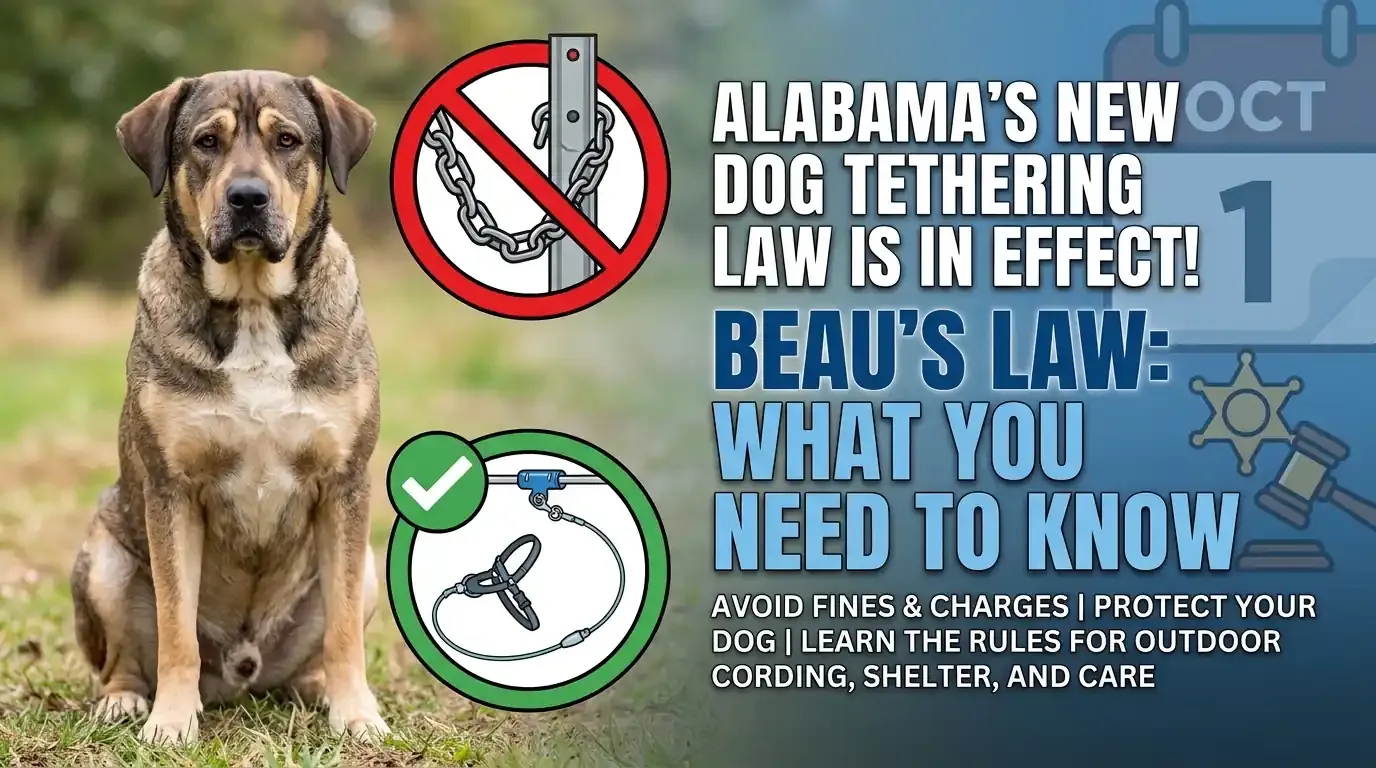
Alabama's New Dog Tethering Law Is Now in Effect. Here's What Dog Owners Should Know.
On October 1, a new Alabama law went into effect that a lot of dog owners haven't heard much about yet. It's called Beau's Law. It spells out how a dog can be tied up or kept outside, and if you get it wrong, you can be charged with a crime.
I'd rather you read about it here than hear about it from an animal control officer at your front gate.
Where the law came from
Beau's Law is Senate Bill 361, sponsored by Senator Garlan Gudger of Cullman. The House amended it, the Senate agreed to the changes on April 8, and Governor Ivey signed it.
The name comes from a dog that was found outside in cold weather with only cardboard for shelter. Most people can agree nobody wants to see that. It still wasn't an easy bill to pass. The House debated it for more than an hour and a half, and it picked up amendments along the way.
Alabama's animal cruelty and neglect laws are still on the books, and the new law says so. What Beau's Law adds is a specific checklist for dogs kept outside.
What the law requires
Tethering. The starting rule is that you can't tie a dog to a stationary object like a tree, pole, stake, or structure. The one legal way to do it is with a trolley system, and the setup has to meet all of these conditions:
- The tether can't be unreasonably heavy for the size of the dog, and it can only connect one dog.
- It can't let the dog leave your property.
- It has to attach to a properly fitted collar or harness, with a swivel on both ends.
- It can't run over an object or edge where the dog could be hurt or strangled, and it has to be set up so the dog can't get tangled in other objects or animals.
- The dog needs access to food, water, and shelter at all times.
Logging chains, choke collars, and pinch collars can't be used to tether a dog at all. A dog on a plain chain tied to a tree or a post doesn't fit that description.
Fenced enclosures. If you keep the dog in an enclosure instead, it has to be secure and fully fenced, big enough for the dog to move around freely, and it can't allow the dog to get off your property. Food, water, and shelter have to be available at all times here too.
Shelter. The shelter has to keep the dog dry and protected from the weather, with shade in the heat and bedding when it's cold. It has to be fully enclosed, with an opening to get in and out and a solid floor. The dog should be able to stand up, turn around, lie down, and stretch out. It has to be made of durable materials, have ventilation, and be kept free of waste, standing water, and debris. And the dog needs unlimited access to it.
Food and water. The law defines these by whether the dog is fed and watered often enough, and in large enough amounts, to avoid starvation, dehydration, or a real risk to its health. Because the definition is about intervals, a bowl that happens to be empty when an officer drives up isn't necessarily a violation. That exact worry came up during the House debate.
Who's exempt
The law doesn't reach everyone who keeps a dog outside. Exempt situations include veterinary practices, boarding kennels and shelters, dog shows and trials, groomers, service and assistance dogs, someone walking a dog on a leash, dogs being lawfully trained to hunt or retrieve, and licensed commercial breeders. Working dogs tied to herding, farming, or hunting are outside the law too.
There's also room for short, temporary situations: tying a dog up outside a business while you're inside, or at a campsite, a recreation area, or your own home, as long as it's for a reasonable amount of time given the weather.
Here's the honest part. The law never says what a reasonable amount of time is. It doesn't put a number of minutes on it. That's where a lot of the disagreements are going to start.
How enforcement works
Counties and cities can appoint animal control officers to investigate complaints, and those officers don't have to be certified police officers.
If a certified officer has probable cause to believe the law was broken, the officer can take the dog if he or she believes its life is in danger, or order you to provide care for the dog at your own expense. A removal or a care order is handled through the hearing procedures in Alabama's existing animal cruelty statutes. The law also says nothing stops an officer from seeking a warrant to come onto private property.
What the penalties look like
A first violation is a Class C misdemeanor. A second is a Class B misdemeanor. A third or later is a Class A misdemeanor. In Alabama, that's up to three months in jail for a Class C, up to six months for a Class B, and up to a year for a Class A, plus fines.
On top of that, anyone who violates the law has to pay the full cost of boarding the dog and any veterinary care. Those bills add up fast.
The cruelty and neglect statutes also still apply, so a separate and more serious charge is possible if the facts support it.
If animal control comes to your door
A few things I'd tell anyone in that spot:
Take care of the dog first. If the dog needs water, shade, or a dry place right now, fix that right now. It's the right thing to do, and it also matters to how the situation looks later.
Be polite, but don't argue your case on the spot. Ask what they're concerned about. You aren't required to give a detailed statement, and what you say in the first few minutes can end up being the State's best evidence.
Document your setup. Dated photos of the tether, the shelter, and the water. Vet records. Receipts. If the dog is being cared for, you want proof of it.
If your dog was taken, don't wait. The hearing process for a removed dog runs on its own track, with its own deadlines. Ask about it right away.
Be careful about just paying a citation. Because the penalty steps up for a second and third violation, how the first one is resolved can matter later. Paying a ticket is not always the cheap option, and we explain why in our article on what a traffic ticket or misdemeanor can really cost.
Most people who end up in this kind of trouble aren't cruel. They're using a setup that's been in the yard for years. If that sounds like yours, a chain and a tree, don't wait for a knock on the door to change it.
Call us
If you've been cited, charged, or had a dog removed, call John Medaris Law at (205) 663-1584. We're at 230 Bearden Road in Pelham. The first consultation is free, and we'll give you a straight answer about where you stand.